The rule in plain English
The national guidance, Permeable surfacing of front gardens, explains the position for houses in England:
- You do not need planning permission for a new or replacement front-garden surface if it is permeable, or if water runs off to a lawn, border or soakaway within the property.
- You do need permission if the surface is impermeable, covers more than 5m², and water would run onto the road or into the drains.
The aim is to reduce surface-water flooding and pollution from paved front gardens.
Surfaces that can comply
| Surface | How it drains | Notes |
|---|---|---|
| Gravel | Through the stones | Simplest, cheapest option |
| Resin-bound | Through the resin layer | Only permeable on an open-graded base, not on solid tarmac |
| Permeable block paving | Through wider joints filled with grit | Needs an open-graded sub-base |
| Porous asphalt | Through the tarmac | Specialist mix and base |
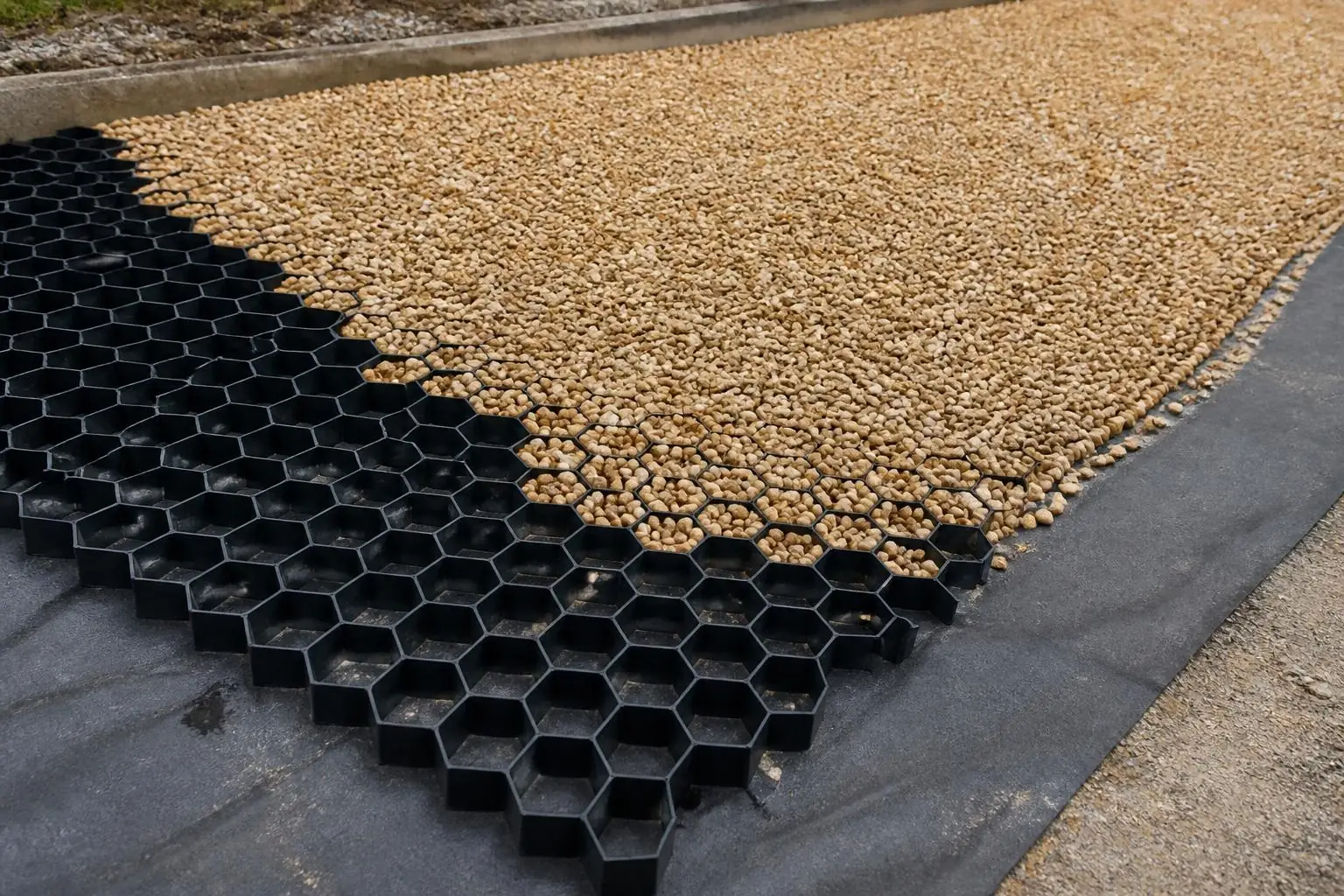
| Grass or gravel grids | Through the cells | Good for occasional parking |
Standard block paving with sand joints, dense tarmac and concrete are treated as impermeable unless the water is directed to a permeable area.
The clay problem
Much of Stockton sits on boulder clay, glacial clay that drains slowly. Water passes through a permeable surface quickly but then soaks into the clay below slowly. Good designs allow for that:
- A deeper open-graded sub-base stores water while it soaks away.
- A soakaway sized for clay is larger than one on sandy ground.
- Falling the drive towards a lawn or planted border gives water a second route.
- An overflow arrangement may be needed in heavy rain.
A percolation test, which measures how quickly water drains from a test hole, takes the guesswork out of sizing a soakaway.
Impermeable drives done legally
If you prefer standard block paving or tarmac, you can still avoid planning permission by draining it within the property, for example with a fall towards a border or a channel drain feeding a soakaway. Alternatively, apply for planning permission.
Other permissions
The drainage rule is separate from:
- a dropped kerb, which needs the council's approval in every case (dropped kerbs);
- conservation area controls such as Article 4 Directions (conservation areas guide).
Common questions
Does the 5m² rule apply to back gardens?
The guidance is about front gardens, the part facing the highway.
Is resin-bound always permeable?
Only when laid on a permeable base. Over solid tarmac or concrete, it is not.
Is block paving permeable?
Standard block paving is not. Permeable block paving, with wider joints and a special base, is.
What happens if I break the rule?
The council can require you to apply for permission retrospectively or change the drive.